120 editions, more than a century of cycling, champions and legendary exploits. Click HERE to retrace the history of Il Lombardia.
Between the 1960s and the 1990s, the Vuelta a España was held in spring and the UCI Road World Championships at the end of the summer. That meant autumn belonged to Il Lombardia, which truly earned its reputation as cycling’s “Autumn World Championship”.
1969: Karstens’ ghost victory and the tragic fate of Monseré
The 1969 edition of Il Lombardia remains a bittersweet one in the race’s history. There was one winner on the road, but another in the record books. Dutchman Gerben Karstens crossed the finish line first in Como ahead of the young Belgian Jean-Pierre Monseré, only to be disqualified after testing positive in the post-race anti-doping control. Victory was therefore awarded to Monseré, who was just 21 years old.
The talented Belgian went on to win the UCI Road World Championship the following year, but in March 1971 he was tragically killed during a training ride after colliding with a car while still wearing the rainbow jersey, one of the darkest moments in professional cycling history. Karstens, whose disqualification was announced several months after the race, always denied knowingly taking any banned substance. He received a one-month suspension from the Italian Cycling Federation but was not sanctioned by the Dutch federation.
For many years, the winner’s trophy remained with the Karstens family, despite requests from Monseré’s relatives after the Belgian’s untimely death. Handing it over, Karstens believed, would have been an admission of guilt. It was only in 2023, one year after Gerben Karstens’ death, that his family agreed to loan the trophy to the KOERS Museum in Roeselare, in the presence of members of the Monseré family.
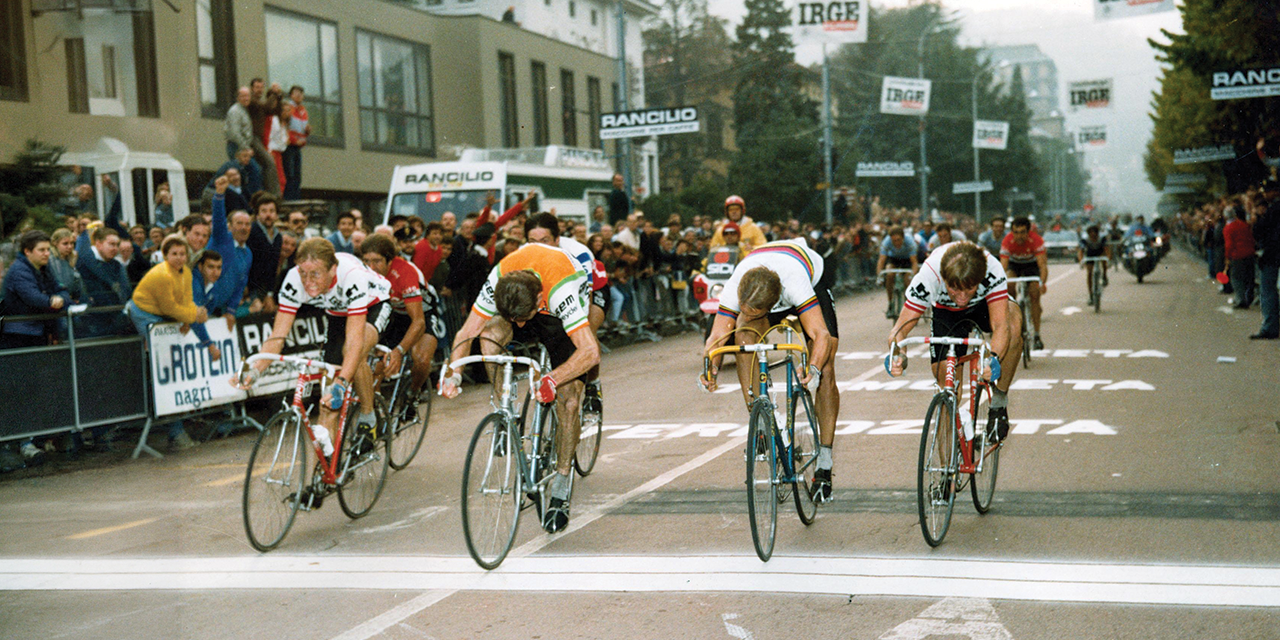
1983: Kelly and a breath-taking photo finish
Among the most iconic images in the long history of Il Lombardia is the finish of the 1983 edition. The photo finish captured four riders separated by only a handful of centimetres, with Sean Kelly claiming the first of his three Lombardia victories ahead of Greg LeMond, Adrie van der Poel—father of Mathieu—and Hennie Kuiper.
The finish carried even greater significance because more than a Monument Classic was at stake. Kelly and LeMond were also battling for the prestigious Challenge Pernod, the predecessor of today’s UCI World Ranking, which crowned the world’s best rider over the course of the season. By finishing second, LeMond retained his lead in the standings, making his defeat in the Race of the Falling Leaves just a little easier to accept.
1992: Rominger shines through rain and darkness
The 1992 Giro di Lombardia was one of the toughest editions ever held, a race that seemed to belong to another era of cycling. The riders rolled out from Monza under torrential rain, thick fog, bitter cold and flooded roads, with the headlights of the race convoy often providing the only visibility.
Tony Rominger attacked on the Esino Lario climb, but the race continued to evolve dramatically. Gianni Bugno, crippled by the cold, lost contact, while Claudio Chiappucci risked everything on the descents and briefly looked capable of turning the race around. Davide Cassani and Raúl Alcalá bridged across, creating a leading group packed with quality. Then, on the climb to Lissolo, hidden by fog and relentless rain, Rominger launched the decisive move almost unnoticed. Cassani cracked, Chiappucci fought on but eventually had to concede. The Swiss rider rode alone to victory in Monza, finishing 41 seconds ahead of Chiappucci and 2’50” clear of Cassani to secure his second Il Lombardia triumph after his first in 1989.
Click HERE to discover more about the century-old history of Il Lombardia.